
The JavaScript floor function is a Math function that returns the largest integer value, which is less than or equal to the specified number or expression. It always rounds a number downwards by moving towards negative infinity.
For example, if we use the floor() function to round 10.98 (Math.floor(10.98), it returns 5 because it is the nearest integer less than or equal to 10.98.
JavaScript floor() syntax
The syntax of the Math.floor function is
Math.floor(number);
Parameters: The floor() function accepts a single parameter. It can be an integer or a floating-point number.
Return Value: The floor() function returns the largest integer value less than or equal to the given parameter (number). In short, it always moves towards negative infinity (rounds downwards).
- This method will return the floor value if the argument is a positive or negative number.
- If the number argument is not a number, it returns NaN.
- And if it is Null, it will return Zero.
JavaScript floor function examples
When we pass a positive floating-point number, the Math.floor() function returns the largest integer value that is less than or equal to the given number.
Here, 15 is the nearest integer less than both 15.98 and 15.01. However, when you pass an integer value, the floor() function returns the same number.
console.log(Math.floor(15.98));
console.log(Math.floor(15.01));
console.log(Math.floor(15));
15
15
15
JavaScript Math.floor negative numbers
Similar to the positive, the Math.floor() function returns the nearest integer rounded downwards. It returns the integer value towards negative infinity or away from zero.
In the following, -100 is the nearest integer to -99.78 and -99.10, which are less than the given number.
console.log(Math.floor(-99.78));
console.log(Math.floor(-99.10));
console.log(Math.floor(-99));
-100
-100
-99
floor() function with Infinity, NaN, and null
When we pass a positive or negative infinity, the floor() function returns the same result. Similarly, it returns NaN for not-a-number values, including NaN and strings. However, if we pass a null value, empty string, the Math.floor() function returns 0 as the output.
console.log(Math.floor(Infinity));
console.log(Math.floor(-Infinity));
console.log(Math.floor(NaN));
console.log(Math.floor("Hello"));
Infinity
-Infinity
NaN
NaN
In the last statement, the floor() function was unable to convert the word to a floating-point number implicitly. So, it returns NaN (not-a-number).
Flooring zeros
When you apply the Math.floor() function on positive and negative zeros, it returns the same result.
console.log(Math.floor(0));
console.log(Math.floor(-0));
0
-0
JavaScript floor complete example
In this JS function example, we will find the floor values of different data types and display the output.
NOTE: Please refer to the JavaScript Math functions article on the JavaScript tutorial page. The last line of this example uses the Math.floor function on a null value, is returning Zero as output.
<!DOCTYPE html>
<html>
<head>
    <title> JavaScriptMathfloorFunction </title>
</head>
<body>
  <h1> JavaScriptFLOORFunction </h1>
  <p id = "Pos"></p>
  <p id = "Neg"></p>
  <p id = "Dec"></p>
  <p id = "Dec1"></p>
  <p id = "Neg_Dec"></p>
  <p id = "Neg_Dec1"></p>
  <p id = "Str"></p>
  <p id = "Exp"></p>
  <p id = "Null"></p>
  <script>
    document.getElementById("Pos").innerHTML = Math.floor(20);
    document.getElementById("Neg").innerHTML = Math.floor(-20);
    document.getElementById("Dec").innerHTML = Math.floor(10.05);
    document.getElementById("Dec1").innerHTML = Math.floor(10.95);
    document.getElementById("Neg_Dec").innerHTML = Math.floor(-6.05);
    document.getElementById("Neg_Dec1").innerHTML = Math.floor(-6.95);
    document.getElementById("Str").innerHTML = Math.floor("JavaScript");
    document.getElementById("Null").innerHTML = Math.floor(null);
  </script>
</body>
</html>
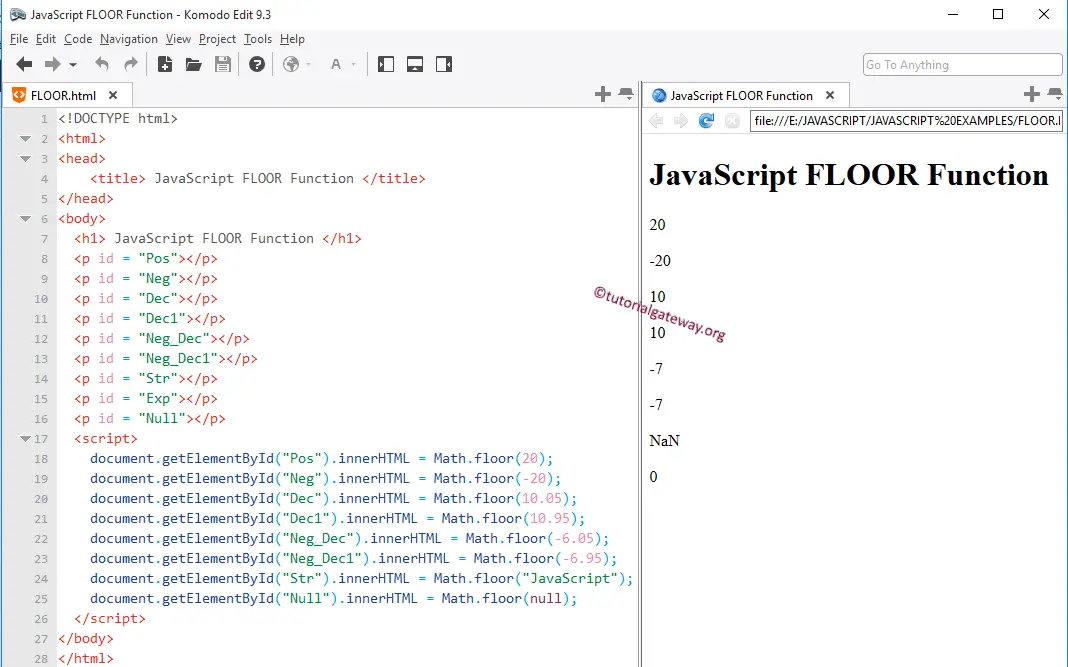
Using the floor() function with string (non-numeric values)
We can use the Math.floor() function on a string data type. However, the string has to be implicitly converted to a floating-point number. If it can’t be converted to a number, the floor() function returns NaN as the output.
let s = "11.98"
let a = "One"
console.log(Math.floor(s));
console.log(Math.floor(a));
11
NaN
JavaScript floor array example
In the following example, we use the Math.floor() function on an array of floating-point numbers. Here, the map() will create a new array by assigning every array item to the floor() function to round the value.
const n = [19.25, 30.58, 22.9, 50.896];

const result = n.map(Math.floor);
console.log(result);
[ 19, 30, 22, 50 ]Using the floor() function on a matrix
const n = [[19.22, 30.58, 40.89], [22.199, 10.5, 50.8296]];

const result = n.map((row) => row.map(Math.floor));
console.log(result);
[ [ 19, 30, 40 ], [ 22, 10, 50 ] ]JavaScript Math.floor array index
We can use the Math.floor() function for array indexing to select a random element from an array. In the following example, on each program run, the JavaScript random() function will select a random array item. Here, the length method restricts the random number from exceeding the highest array index value.
const fruits = ['Apple', 'Banana', 'Grape', 'Kiwi'];

const i = Math.floor(Math.random() * fruits.length);

console.log('index =', i);
console.log('Fruit Name = ',fruits[i]);
index = 2
Fruit Name =  Grape
JavaScript Math.floor to 2 decimal places
As we all know, the floor() function returns the nearest integer. However, when performing scientific calculations, decimal precision is very important.
We use the following function to floor the given floating-point number to 2 or more decimal places.
function twoDecimals(n, precision = 0)
{
  const factor = Math.pow(10, precision);
  return n.map((i) => Math.floor(i * factor) / factor);
}

const n = [19.2532, 30.528, 22.199, 50.8296];
console.log(twoDecimals(n, 2));
[ 19.25, 30.52, 22.19, 50.82 ]JavaScript floor division
As we all know, floor division is nothing but dividing one operand by another and rounding the result. There is no special operator for performing a floor division.
For example, when we divide 10 by 3, the result becomes 3.5. However, when we use the floor() function to perform the floor division, the result becomes 3.
console.log(Math.floor(10/3));
3When we use a negative value, the result moves towards negative infinity. For instance, if we divide 20 by 3, the result is -6.66, and the floor value is -7.
console.log(Math.floor(-20/3));
-7Web applications: Pagination Example
In a web application that displays products or items on a page, each page can store 10 items. We can use the Math.floor() function to calculate the total number of pages required to store the inventory.
const items = 25;
const perPage = 10;
let totalPages = Math.floor(items / perPage);
console.log(totalPages);
2Booking an appointment (Time slot)
const hour = 11.45;

const slot = Math.floor(hour);
console.log(slot);
11JavaScript Math.floor random number between 1 and 10
To generate a random number between 1 and 10, we must use the random() function and apply the floor() function to round the floating-point number. The following example returns a random number on each execution.
const min = 1;
const max = 10;

const randomNum = Math.floor(Math.random() * (max - min + 1)) + min;
console.log(randomNum);
3JavaScript Math.floor() vs Math.ceil() vs Math.trunc
All three (floor, ceil, and trunc) help round floating-point numbers.
- Math.floor: It rounds down the given number to the nearest (previous) integer (moves towards negative infinity).
- JavaScript Math.ceil: It rounds up the given number to the nearest (next) integer (moves towards positive infinity).
- JavaScript Math.trunc: It removes the decimal points (fractional points) from a number and keeps the integer value.
console.log(Math.floor(10.78));
console.log(Math.ceil(10.78));
console.log(Math.trunc(10.78));
console.log("===Negative Number===")
console.log(Math.floor(-10.78));
console.log(Math.ceil(-10.78));
console.log(Math.trunc(-10.78));
10
11
10
===Negative Number===
-11
-10
-10
Related Math functions