
The JavaScript ceil function is a Math function that returns the smallest integer value, which is greater than or equal to the specified expression or a number. It always rounds towards positive infinity. For instance, Math.ceil(1.2) is 2.
JavaScript ceil() syntax
The syntax of the Math.ceil() function is
Math.ceil(number);
Parameters: This function accepts a single parameter (number) to perform ceiling.
Return Value: The JavaScript Math.ceil() function returns the nearest integer moving upwards. In short, it returns the smallest integer greater than or equal to the given number argument.
- If the number argument is a positive or negative number, it will return the ceiling value.
- If the specified number argument is not a number, it will return NaN.
- And if it is Null, it returns zero.
TIP: To utilize the function, we must use Math.ceil() because ceil() is a static method of Math.
JavaScript ceil Example
In this section, we will explain the Math.ceil() function behaviour on positive, negative, zero, string, and other values.
ceil() function on positive floating-point numbers
As we mentioned earlier, when we pass a positive floating-point number, the Math.ceil() function rounds it to the nearest integer value. It moves upwards towards positive infinity.
For instance, if we pass positive integer or floating-point numbers 20.01 or 20.88, the ceil() function will return 21 as output.
console.log(Math.ceil(20.01));
console.log(Math.ceil(20.88));
21
21
However, when we pass the integer value 20 as the input, the ceil() function returns the same value (20) as output.
console.log(Math.ceil(20));
20JavaScript Math.ceil negative numbers
When we pass a negative floating-point number or integer to the ceil() function, the rounded value will move towards zero (towards the positive direction). For instance, if we pass negative values, such as -10.50 or -10, the ceil() function will return -10 as the output. Remember, -10 is greater than -10.50.
console.log(Math.ceil(-10));
console.log(Math.ceil(-10.98));
-10
-10
Rounding the Numeric string
When we pass a numeric string (it’s basically a number in string format), the Math.ceil() function automatically converts the string data type to a float and returns the ceiling value.
const s = "50.895"
console.log(Math.ceil(s))
51ceil 0
If we use the Math.ceil() function with a positive or negative 0, it returns the same output.
console.log(Math.ceil(0));
console.log(Math.ceil(-0));
0
-0
JavaScript Math.ceil() function example
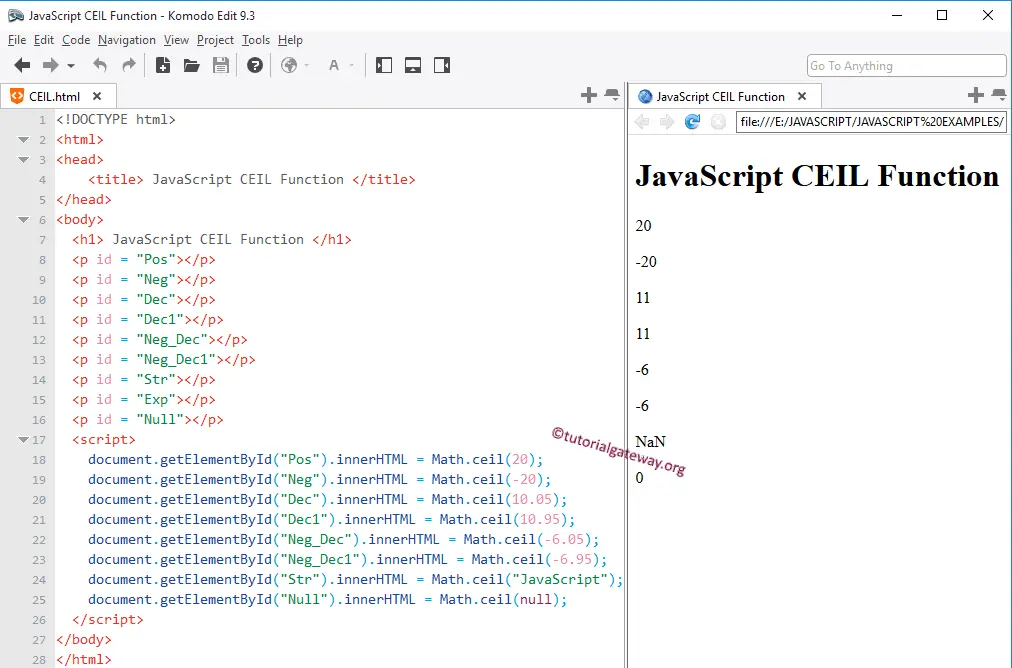
In this example, we will use this one to find the ceiling values of different data types and display the output.
- Within the first two statements, we used it directly on both the positive and negative integers.
- Following four statements, we used the ceil Function on both the Positive and negative Decimal values.
- Next, we tried on the String value. As we said before, this will return NaN as output. Please refer to the JavaScript Math functions article from the Learn JavaScript page.
- Last, we tried this Math ceil function on the Null value, and JS returns zero as output.
<!DOCTYPE html>
<html>
<head>
    <title> JavaScriptCEILFunction </title>
</head>
<body>
  <h1> JavaScriptCEILFunction </h1>
  <p id = "Pos"></p>
  <p id = "Neg"></p>
  <p id = "Dec"></p>
  <p id = "Dec1"></p>
  <p id = "Neg_Dec"></p>
  <p id = "Neg_Dec1"></p>
  <p id = "Str"></p>
  <p id = "Exp"></p>
  <p id = "Null"></p>
  <script>
    document.getElementById("Pos").innerHTML = Math.ceil(20);
    document.getElementById("Neg").innerHTML = Math.ceil(-20);
    document.getElementById("Dec").innerHTML = Math.ceil(10.05);
    document.getElementById("Dec1").innerHTML = Math.ceil(10.95);
    document.getElementById("Neg_Dec").innerHTML = Math.ceil(-6.05);
    document.getElementById("Neg_Dec1").innerHTML = Math.ceil(-6.95);
    document.getElementById("Str").innerHTML = Math.ceil("JavaScript");
    document.getElementById("Null").innerHTML = Math.ceil(null);
  </script>
</body>
</html>
Using ceil() with Infinity and NaN
For positive or negative infinity and nan values, the ceil() function returns the same output.
console.log(Math.ceil(Infinity));
console.log(Math.ceil(-Infinity));
console.log(Math.ceil(NaN));
Infinity
-Infinity
NaN
JavaScript array Math.ceil
Apart from individual numbers, we can use the Math.ceil() function on array items to round the array elements to the nearest integer. Here, the map() helps to create a new array by applying the ceil() function to individual array items.
const numbers = [10.25, 25.89, 30.78, 44.01, 59.10];

const res = numbers.map(Math.ceil);
console.log(res);
[ 11, 26, 31, 45, 60 ]Apply ceiling on nested arrays
Similar to the above, we can use the map() function to apply the ceil() function on nested array items.
const numbers = [[10.25, 25.89], [30.78, 44.01], [59.10, 69.3, 99.2]];

const res = numbers.map(r => r.map(Math.ceil));
console.log(res);
[ [ 11, 26 ], [ 31, 45 ], [ 60, 70, 100 ] ]JavaScript ceil() function: Real-time examples
What is the ceil of 2?
2. As it is an integer, the Math.ceil() function returns the same value as output.
How to round 2.2 to 3 in JS?
We can use the Math.ceil() function, which rounds a floating-point number to the next integer.
console.log(Math.ceil(2.2));
3JavaScript math.ceil to 2 decimal places
By default, the Math.ceil() function returns an integer. However, we can perform mathematical calculations to round the decimal precision. Instead of the ** operator, we can use the JavaScript pow() function. To round downwards, use the JavaScript floor() function.
function decimalPrecision(n, precision = 0)
{
  const dec = 10 ** precision;
  return Math.ceil((n + Number.EPSILON) * dec) / dec;
}

console.log(decimalPrecision(300.35259, 2));
console.log(decimalPrecision(673.35259, 3));
300.36
673.353
Pagination: Total Pages required
const totalRecords = 243;
const perPage = 10;

const totalPages = Math.ceil(totalRecords / perPage);
console.log("Required Pages = ", totalPages);
Required Pages = 25Calculate the time required to download
If we have a file size of 150042 MB and the internet download speed is 100 MB/min.
const fileSize = 150042;
const speed = 100;

const t = Math.ceil(fileSize / speed);
console.log("Time in Minutes = " + t);
Time in Minutes = 1501JavaScript ceil() Error and Exceptions
When we pass an argument that can’t be implicitly converted to a numeric value, the ceil() function will return NaN. For instance, Hi cannot be converted to a number, so it returns NaN.
console.log(Math.ceil("Hi"));
NaNIf you pass a null value or an empty string, the ceil() function returns 0 as the output. When you pass an empty array, it returns 0.
const a = []
console.log(Math.ceil(a));

console.log(Math.ceil(" "));
console.log(Math.ceil(null));
0
0
0
Related Math functions