
How to write a query to Calculate Running Total in SQL Server with example. For this frequently asked interview question, we will use the below-shown data.
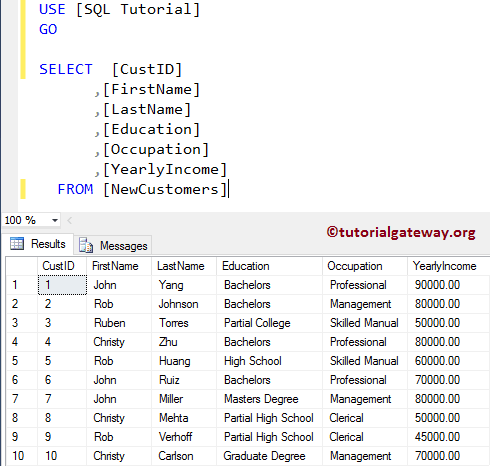
Calculate Running Total Example
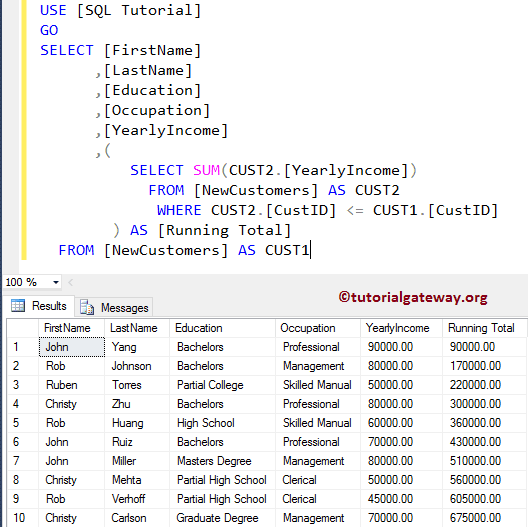
In this example, we will show you how to find the Running Total using the SUBQUERY. Please refer to the SQL SUBQUERY article on the SQL tutorial page.
SELECT [FirstName]
      ,[LastName]
      ,[Education]
      ,[Occupation]
      ,[YearlyIncome]
      ,(
	 SELECT SUM(CUST2.[YearlyIncome])
         FROM [NewCustomers] AS CUST2
         WHERE CUST2.[CustID] <= CUST1.[CustID]
	) AS [Running Total]
  FROM [NewCustomers] AS CUST1
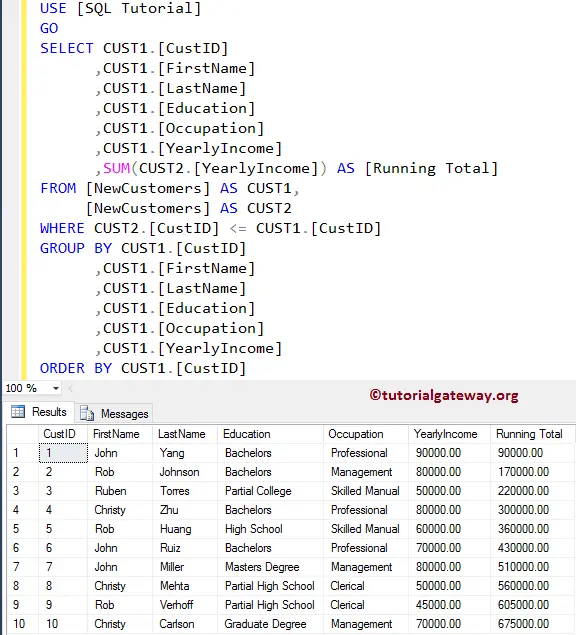
This example shows how to calculate the Running Total using the JOIN, GROUP BY, and ORDER BY clauses. Please refer to the SQL INNER JOIN, SQL GROUP BY, and SQL ORDER BY Clauses.
SELECT CUST1.[CustID]
      ,CUST1.[FirstName]
      ,CUST1.[LastName]
      ,CUST1.[Education]
      ,CUST1.[Occupation]
      ,CUST1.[YearlyIncome]
      ,SUM(CUST2.[YearlyIncome]) AS [Running Total]
FROM [NewCustomers] AS CUST1,
     [NewCustomers] AS CUST2
WHERE CUST2.[CustID] <= CUST1.[CustID]
GROUP BY CUST1.[CustID]
	,CUST1.[FirstName]
        ,CUST1.[LastName]
        ,CUST1.[Education]
        ,CUST1.[Occupation]
        ,CUST1.[YearlyIncome]
ORDER BY CUST1.[CustID]
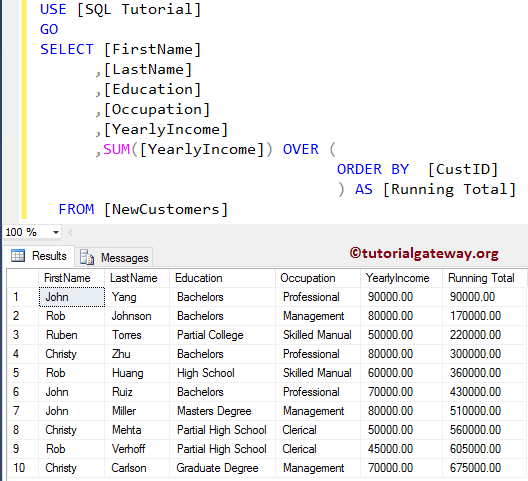
In this Server example, we will find the Running Total using the SUM Function and OVER. Refer to the SQL SUM function.
SELECT [FirstName]
      ,[LastName]
      ,[Education]
      ,[Occupation]
      ,[YearlyIncome]
      ,SUM([YearlyIncome]) OVER (
			          ORDER BY  [CustID]
				) AS [Running Total]
  FROM [NewCustomers]
and the more traditional way is
SELECT [FirstName]
      ,[LastName]
      ,[Education]
      ,[Occupation]
      ,[YearlyIncome]
      ,SUM([YearlyIncome]) OVER (
			          ORDER BY  [CustID] ROWS UNBOUNDED PRECEDING
				) AS [Running Total]
  FROM [NewCustomers]
Comments are closed.