
Python clear function is one of the set methods used to clear or remove total set items. In this section, we discuss how to use this function with practical examples. The basic syntax behind this set clear function is as:
set_Name.clear()
Python set clear Example
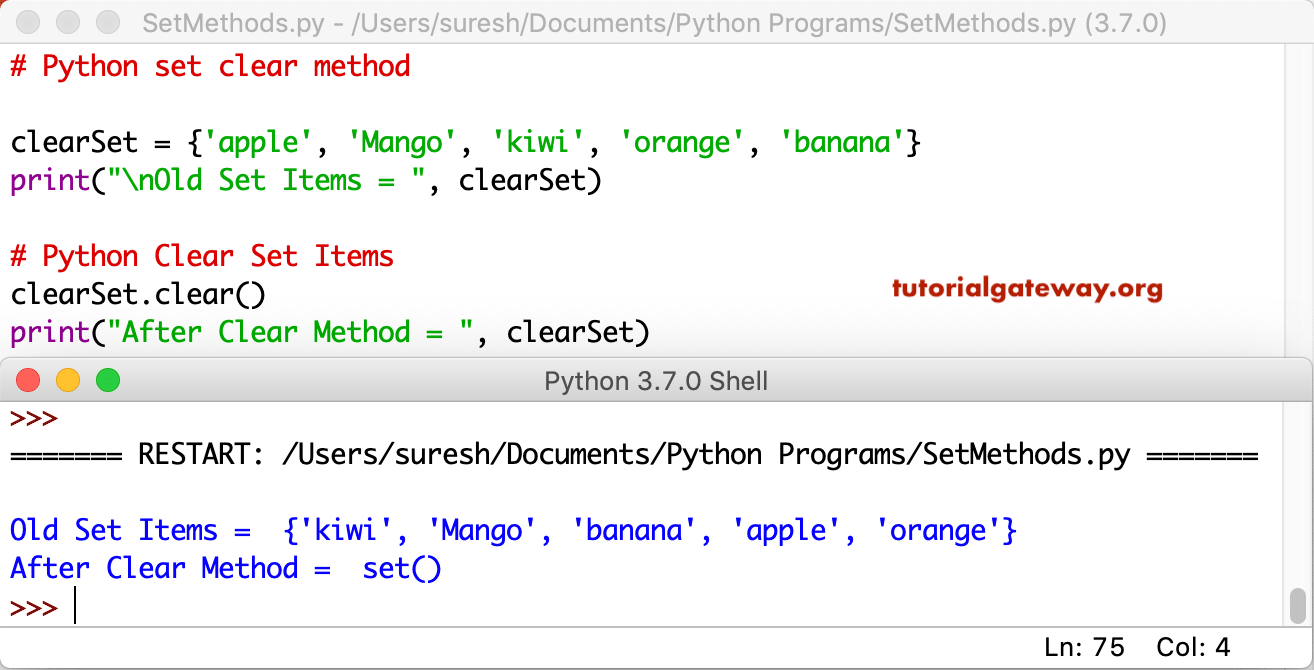
This method helps you to clear or remove the total number of items in a given set. The below code uses this method to remove items from a clearSet.
clearSet = {'apple', 'Mango', 'kiwi', 'orange', 'banana'}
print("\nOld Set Items = ", clearSet)

clearSet.clear()
print("After Clear Method = ", clearSet)
clear Example 2
clearIntSet = {15, 25, 35, 45, 55}
print("\nOld Items = ", clearIntSet)

clearIntSet.clear()
print("After = ", clearIntSet)
Old Items = {35, 45, 15, 55, 25}
After = set()
TIP: Please refer to the Python tutorial page to understand everything about Python Sets.
After executing this clear method, it returns an empty = set().
mySet = {1, 2, 3, 4, 5, 6, 7, 8, 9}
print("Old Items = ", mySet)

mySet.clear()
print("New Items = ", mySet)

FruitSet = {'apple', 'Mango', 'orange', 'banana', 'cherry','kiwi'}
print("\nOld Items = ", FruitSet)

FruitSet.clear()
print("New Items = ", FruitSet)
Old Items = {1, 2, 3, 4, 5, 6, 7, 8, 9}
New Items = set()

Old Items = {'cherry', 'kiwi', 'Mango', 'banana', 'apple', 'orange'}
New Items = set()
Difference between Python set clear() and reassigning an empty set
If the task is to delete all items in a set that does not have any references to it, both the set.clear() function and reassigning to an empty set returns the same result. However, if there are any references, both behave differently.
In short, if you want the original set() and its references to be empty, use the clear() function. If the requirement is to delete the current set and keep the references as they are (unchanged), prefer reassigning an empty set option.
Using Python set clear() method
In the following example, we declared a set. Next, we used the Python assignment operator to refer to this set. Once we used the clear() method, both the original set (s) and their reference (a) become empty.
s = {10, 20, 30,40}
a = s
print(a)

s.clear()
print(s)
print(a)
{40, 10, 20, 30}
set()
set()
Reassigning to an empty set
In the following example, we reassigned the original set to an empty set using the set() function. Here, the original set becomes empty, whereas the reference set (a) still holds the values.
s = {10, 20, 30,40}
a = s
print(a)

s = set()
print(s)
print(a)
{40, 10, 20, 30}
set()
{40, 10, 20, 30}
Python set clear vs discard vs remove
The set clear(), discard(), and remove() methods help to remove items from an existing set. However, their functionality differs.
- clear() function removes all elements in a set at once. After implementing the set.clear() method, it returns an empty set.
- Python set discard function deletes a specific element from a list. If the user-given element is not present in a set, it does nothing.
- Python set remove() function deletes a specific element from a list. If the user-given element is not present in a set, it raises KeyError.
Using clear()
As you can see, after implanting the set.clear() function, it returns an empty set.
s = {10, 20, 30,40}
s.clear()
print(s)
set()Using set dicard()
When we try to remove a non-existing item (100) from a set, it does nothing and prints the result.
s = {10, 20, 30,40}
s.discard(20)
print(s)

s.discard(100)
print(s)
{40, 10, 30}
{40, 10, 30}
Using set remove()
When we try to delete an existing item, it simply removes that item from a set. However, when we try to remove 11, it raises KeyError. Also, refer to the Python set pop method from the list of available Python set functions.
s = {10, 20, 30,40}
s.remove(30)
print(s)

s.remove(111)
print(s)
{40, 10, 20}
KeyError: 111