
The Python asin function calculates the trigonometry Arc Sine for the specified expression. The asin or Arc Sine is also called the inverse of a Sine. In this section, we discuss how to use asin function with examples.
The syntax of the Python asin Function is as shown below.
math.asin(number);
Number: A valid numerical expression to find the Arc Sine value.
- If the number argument is a positive or negative number, the asin function returns the Arc Sine value.
- If it is not a number, the asin function returns TypeError.
- And if it is outside the range -1 and 1, the asin function returns ValueError.
Python asin Function Example
The asin Function allows you to find the trigonometry Arc Sine for the numeric values. In this asin example, we will find the Arc Sine values of different data types and display the output.
TIP: Please refer to the Python sin Function article from the Python basics page to understand the Sine Function.
import math

Tup = (0.21, 0.12, 0.39, -0.89 , 0.42) # Tuple Declaration
Lis = [-0.1, 0.92, 0.35, -0.46 , 0.85] # List Declaration

print('Arc Sine value of Positive Number = %.2f' %math.asin(1))
print('Arc Sine value of Negative Number = %.2f' %math.asin(-1))

print('Arc Sine value of Tuple Item = %.2f' %math.asin(Tup[3]))
print('Arc Sine value of List Item = %.2f' %math.asin(Lis[2]))

print('Arc Sine value of Multiple Number = %.2f' %math.asin(0.10 + 0.20 - 0.40))
print('Arc Sine value of String Value = ', math.asin('Python'))
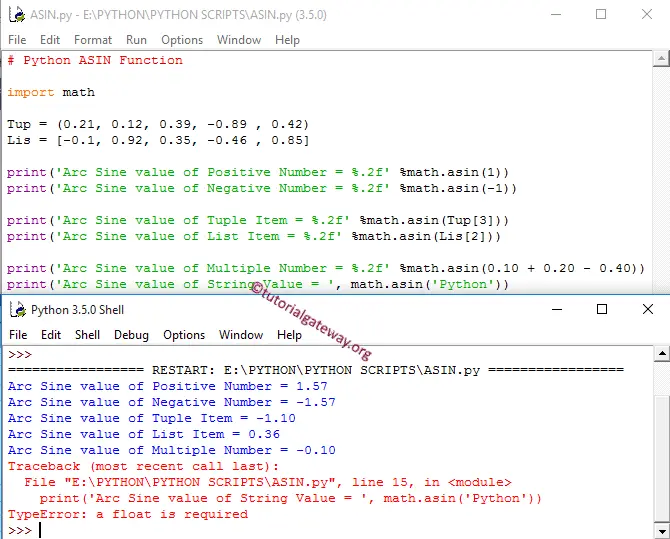
First, we used the asin Function directly on both Positive integer and negative integer. The following statements find the Arc Sine of the corresponding values.
print('Arc Sine value of Positive Number = %.2f' %math.asin(1))
print('Arc Sine value of Negative Number = %.2f' %math.asin(-1))
Next, we used the Function on Python Tuple and Python List items. If you see the screenshot above, the asin function works perfectly on list and tuple items.
print('Arc Sine value of Tuple Item = %.2f' %math.asin(Tup[3]))
print('Arc Sine value of List Item = %.2f' %math.asin(Lis[2]))
Next, we used the asin method from the list of math functions directly on multiple values.
print('Arc Sine value of Multiple Number = %.2f' %math.asin(0.10 + 0.20 - 0.40))
Within the last statement, We tried the asin Function on the String value, which returns TypeError.
print('Arc Sine value of String Value = ', math.asin('Python'))
Please refer to the Python acos and Python atan methods from the list of Python math functions to find the arc cosine and arc tangent values.
Does Python math.asin() function returns radians or degrees?
By default, the built-in math.asin() function returns the result in radians. If you want the result to be in degrees, use the degrees() function.
In the following example, x returns the arc sine value of 0.75 in radians. Next, we used the degrees() function to convert the asin() returned radians to degrees. Please visit our Python radians to Python degrees articles.
import math

x = math.asin(0.75)
print(x)
print(math.degrees(x))
0.848062078981481
48.590377890729144
Why math.asin() function throws ValueError?
The asin() function accepts numbers between -1 and 1. If we pass any value out of this range, the function will throw a ValueError. Remember, always pass values between -1 and 1.
import math
x = math.asin(1.5)
print(x)
ValueError: math domain error