
The C abs function is one of the Math methods used to return the absolute positive value of a given number. It is very helpful in system processing, for instance, we need absolute values in signal processing, embedded control systems, etc.
In simple terms, the C abs() function checks whether the given value is a negative number. If true, negate it (convert to an equivalent positive number). If it is a positive number, return the same number (unchanged).
C abs function syntax
The syntax of the math library’s abs function, which returns the absolute value, is as shown below.
int abs(int number);
Parameters
The abs method accepts a single parameter, and it should be an integer value.
Return Value
It returns an integer data type, which is the absolute value of a given parameter.
Header File required
To use the abs() function, we must include the <math.h> header file.
#include <stdlib.h>
Or
#include <math.h>
NOTE: The abs() function does not work with floating-point numbers.
C abs Function on negative and positive numbers
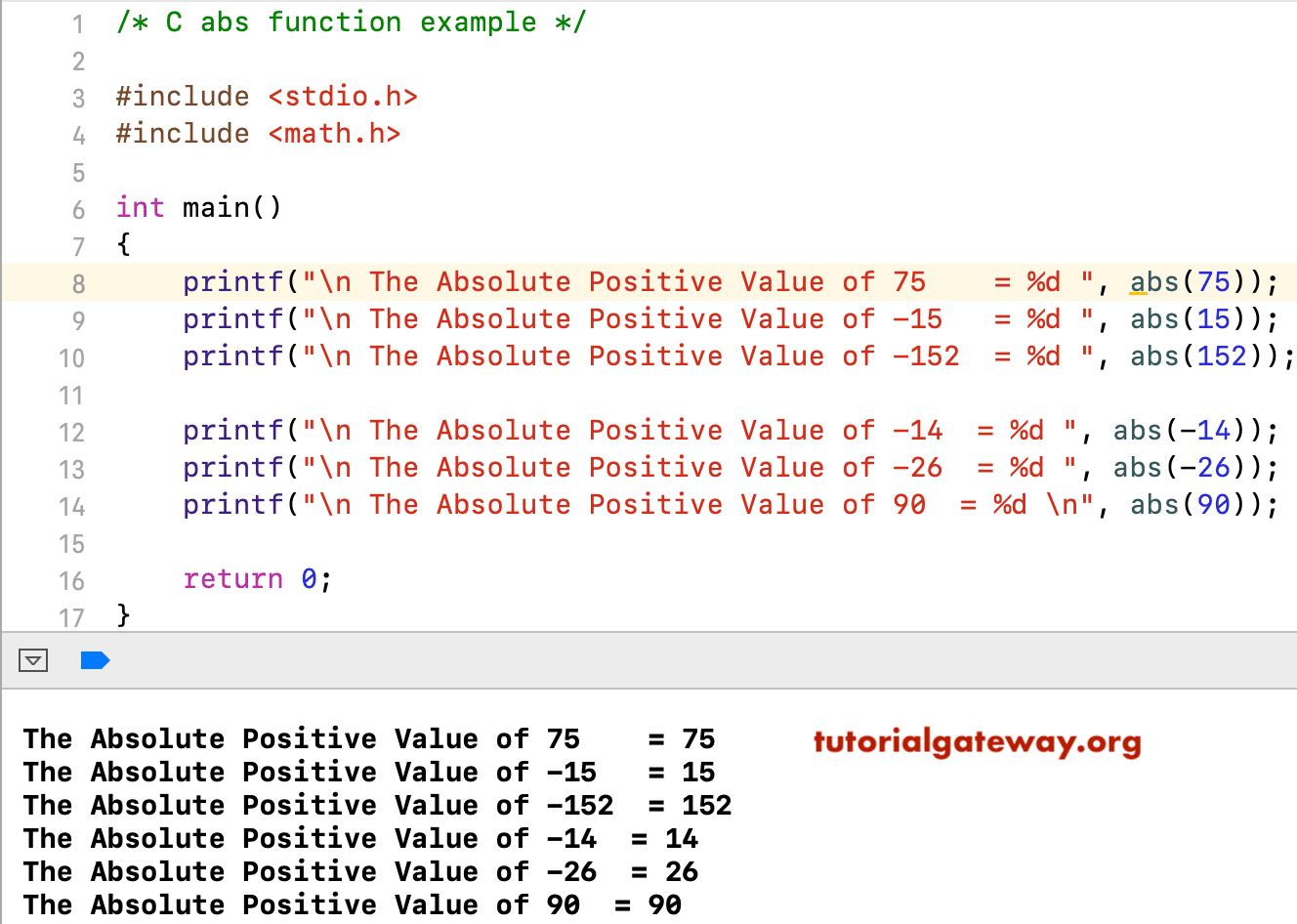
The math.abs function accepts any integer value and returns the absolute positive integer of a user-given number. In this program, we will find the same and display the output.
NOTE: As we mentioned earlier, when we pass a positive number, it remains unchanged.
#include <stdio.h>
#include <math.h>

int main()
{
    printf("\n The Absolute Positive Value of 75    = %d ", abs(75));
    printf("\n The Absolute Positive Value of -15   = %d ", abs(15));
    printf("\n The Absolute Positive Value of -152  = %d ", abs(152));

    printf("\n The Absolute Positive Value of -14  = %d ", abs(-14));
    printf("\n The Absolute Positive Value of -26  = %d ", abs(-26));
    printf("\n The Absolute Positive Value of 90  = %d \n", abs(90));

    return 0;
}
abs() with Zero
#include <stdio.h>
#include <math.h>
int main()
{
    printf("%d", abs(0));
    return 0;
}
0Absolute Value of User-Entered Number
In this C Programming tutorial example, we are allowing the user to enter their value. Next, this program utilizes the abs() math function to find the absolute value of a positive number.
#include <stdio.h>
#include <math.h>
int main()
{
    int number;
    printf(" Please Enter any Numeric Value:  ");
    scanf("%d", &number);

    printf("\nThe Absolute Positive Value of %d = %d", number, abs(number));
    return 0;
}
 Please Enter any Numeric Value:  -987
 The Absolute Positive Value of -987 = 987
TIP: Please refer to the C ceil(), C floor(), C round(), and C pow() functions from the available math functions in C.
C abs() function does not modify the original number
The math.abs() function does not modify the original number passed to it. Instead, it returns a new integer value.
- If you use it instead of the printf() statement, it shows the absolute value. However, the original value is unchanged.
- Correct way: We must assign the abs() function result to a new variable to see or use it for further calculations.
#include <stdio.h>
#include <math.h>

int main()
{
    int n = -42;
    int a = abs(n);
    printf("%d", a);
    printf("\n%d", abs(n));
    printf("\n%d", n);
    return 0;
}
42
42
-42
Using the C abs() function with floating-point numbers
As we mentioned previously, the abs() function belongs to an integer type. If you pass a floating-point number, it won’t return the absolute value.
#include <stdio.h>
#include <math.h>
int main()
{
    float n = -12.5;
    printf("%f", abs(n));
    return 0;
}
0.000Fix: Convert Float to Int
We can change the format specifier to convert the float to an int and return the result.
printf("%d", abs(n));
12Fix: fabs() function
We can use the fabs() function, which accepts a floating-point number and returns the absolute value as a float.
#include <stdio.h>
#include <math.h>

int main()
{
    float n = -12.5;
    printf("%.2f", fabs(n));
    return 0;
}
12.50Different absolute functions
The list of functions that return the absolute values is:
- Integers – abs()
- Floating-point numbers –C fabs()
- Long Data Type = labs()
- Long long Data Type = llabs()
Water System Example: Temperature Monitoring
The absolute values play a vital role in finding the difference between two values. For instance, calculating the deviation between the actual maintained temperature and the current processing values.
#include <stdio.h>
#include <math.h>

int main()
{
    int actual = 48;
    int current = 32;
    int deviation = abs(current - actual);
    printf("%d", deviation);
    return 0;
}
16abs(INT_MIN)
As we all know,
- INT_MAX = 2147483647
- INT_MIN = -2147483648
When we try to find the absolute value of INT_MIN, the returned value must be 2147483648, which is above the integer range. It may show unpredictable results.
One solution is to use the if statement and return the INT_MAX value for the INT_MIN.
#include <stdio.h>
#include <math.h>
#include <limits.h>

int main()
{
    int n = INT_MIN;
    if (n == INT_MIN)
    {
        printf("%d\n", INT_MAX);
    }
    else
    {
        printf("%d\n", abs(n));
    }
    return 0;
}
2147483647