
How to write a C Program to Print Prime Numbers from 1 to 100 or Minimum to a maximum or within a range and calculate the sum using For Loop and While Loop.
C Program to Print Prime Numbers from 1 to 100 Using While Loop
In this program to return prime numbers from 1 to 100, we used the nested while loop along with multiple if statements to get the output.
If you don’t understand the While, please refer to C while loop article.
#include <stdio.h>

int main()
{
  int i, a = 1, count;


  while(a <= 100)
  {
    count = 0;
    i = 2;
    while(i <= a/2)
    {
      if(a%i == 0)
      {
        count++;
	break;
      }
      i++;
    }
    if(count == 0 && a != 1 )
    {
	printf(" %d ", a);
    }
    a++;
  }
  return 0;
}
2 3 5 7 11 13 17 19 23 29 31 37 41 43 47 53 59 61 67 71 73 79 83 89 97It is the same as above, but we allows the user to choose the min and max value to print in between them.
#include <stdio.h>

int main()
{
  int i, Number, count, Minimum, Maximum;

  printf("\n Please Enter the Minimum & Maximum Values\n");
  scanf("%d %d", &Minimum, &Maximum);
  Number = Minimum;

  printf("Prime Numbers Between %d and %d are:\n", Minimum, Maximum);
  while(Number <= Maximum)
  {
    count = 0;
    i = 2;
    while(i <= Number/2)
    {
      if(Number%i == 0)
      {
        count++;
	break;
      }
      i++;
    }
    if(count == 0 && Number != 1 )
    {
       printf(" %d ", Number);
    }
    Number++;
  }
  return 0;
}
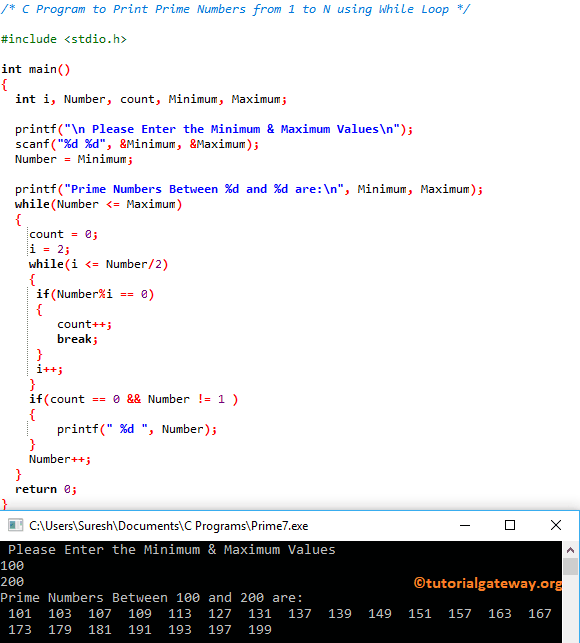
C Program to Print Prime Numbers from 1 to 100 Using For Loop
In this program, the first C For Loop will make sure that the value is between them.
#include <stdio.h>

int main()
{
  int i, N, count;


  for(N = 1; N <= 100; N++)
  {
    count = 0;
    for (i = 2; i <= N/2; i++)
    {
  	if(N%i == 0)
  	{
     	  count++;
  	  break;
	}
    }
    if(count == 0 && N != 1 )
    {
	printf(" %d ", N);
    }
  }
  return 0;
}
2 3 5 7 11 13 17 19 23 29 31 37 41 43 47 53 59 61 67 71 73 79 83 89 97TIP: We already explained the logic to check whether the given is C Program to Check Prime Number or not article in C language.
Instead of printing fixed values, you can allow the user to decide the minimum and maximum values. This C program allows the user to enter Minimum and Maximum values.
Next, this program prints prime numbers between Minimum and Maximum values using For Loop.
#include <stdio.h>

int main()
{
  int i, val, count, Minimum, Maximum;

  printf("\n Please Enter the Minimum & Maximum Values\n");
  scanf("%d %d", &Minimum, &Maximum);

  printf("Between %d and %d are:\n", Minimum, Maximum);
  for(val = Minimum; val <= Maximum; val++)
  {
    count = 0;
    for (i = 2; i <= val/2; i++)
    {
      if(val%i == 0)
      {
  	count++;
  	break;
      }
    }
    if(count == 0 && val != 1 )
    {
       printf(" %d ", val);
    }
  }
  return 0;
}
 Please Enter the Minimum & Maximum Values
20
150
Between 20 and 150 are:
 23  29  31  37  41  43  47  53  59  61  67  71  73  79  83  89  97  101  103  107  109  113  127  131  137  139  149
Sum of Prime Numbers from 1 to 100 using for loop
This program finds the prime numbers between 1 and 100 using for loop, and it’s going to adds them to calculate the sum.
#include <stdio.h>

int main()
{
  int i, Num, count, Sum = 0;

  for(Num = 1; Num <= 100; Num++)
  {
    count = 0;
    for (i = 2; i <= Num/2; i++)
    {
  	if(Num%i == 0)
  	{
  	   count++;
  	   break;
	}
    }
    if(count == 0 && Num != 1 )
    {
	Sum = Sum + Num;
    }
  }
  printf(" Sum between 1 to 100 =  %d", Sum);
  return 0;
}
Sum between 1 to 100 = 1060Instead of adding first 1 to 100, you can allow the user to decide the minimum and maximum values. This code allows the user to enter Minimum and Maximum values. Next, this C program finds the sum of prime numbers between Minimum and Maximum values using the For loop.
#include <stdio.h>

int main()
{
  int i, Num, count, Sum = 0, Minimum, Maximum;

  printf("\n Please Enter the Minimum & Maximum Values\n");
  scanf("%d %d", &Minimum, &Maximum);

  for(Num = Minimum; Num <= Maximum; Num++)
  {
    count = 0;
    for (i = 2; i <= Num/2; i++)
    {
  	if(Num%i == 0)
  	{
     	  count++;
  	  break;
	}
    }
    if(count == 0 && Num != 1 )
    {
       Sum = Sum + Num;
    }
  }
  printf(" Sum between %d and %d =  %d", Minimum, Maximum, Sum);
  return 0;
}
 Please Enter the Minimum & Maximum Values
100
200
 Sum between 100 and 200 =  3167
Also Read
- C Program to Calculate Product of Digits of a Number
- C Program to Find the Prime Factors of a Number
Comments are closed.