
The numbers that are completely divisible by the given value (it means the remainder should be 0) are called factors of a given number. Let us see how to write a C Program to find Factors of a Number using FOR LOOP, WHILE LOOP, Pointers, and FUNCTIONS.
C Program to Find Factors of a Number Using For Loop
This program allows the user to enter any integer value. By using this value, this program finds the Factors of a number using For Loop.
#include <stdio.h>

int main()
{
  int i, Number;

  printf("\n Please Enter any number to Find Factors \n");
  scanf("%d", &Number);

  printf("\n Factors of the Given Number are:\n");
  for (i = 1; i <= Number; i++)
   {
     if(Number%i == 0)
        {
		 printf(" %d  ", i);
		}
   }

  return 0;
}
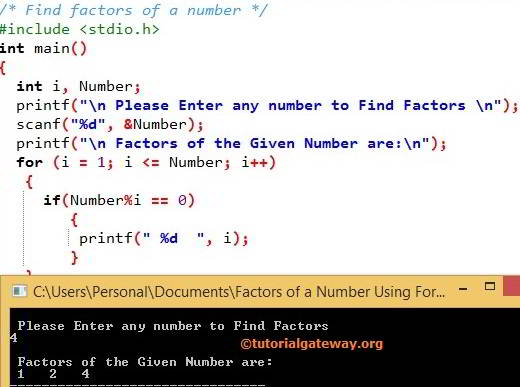
Within this program to find factors of a number, We declared two integer variables i and number. Next, we initialized the integer i value to 1, and also (i <= Number) condition will help the loop to terminate when the condition fails.
for (i = 1; i <= Number; i++)
   {
     if(Number%i == 0)
        {
		 printf(" %d  ", i);
		}
   }
Within the C for loop, there is an C If statement to check whether the Number divisible by i is exactly equal to 0 or not. If the condition is True, then it will print that i value else it will skip that particular value and check the condition for the next value. The user entered integer in the above C Programming example is 4
First Iteration
i = 1 and Number = 4 – It means (i <= Number) is True.
Now, Check the if condition – if (Number%i == 0)Number%i == 0 => (4%1 ==0) – This condition is TRUE. So, 1 is printed
i++ means i will become 2
The second Iteration of the program to find the factorial of a number
i = 2, Number = 4 – It means (2 <= 4) is True
if(Number%i == 0) = if(4%2 ==0) – This condition is TRUE So, 2 is printed
Third Iteration
i = 3, Number = 4 – It means (3 <= 4) is True
if(Number%i == 0) = if(3 % 2 ==0) – This condition is FALSE So, 3 Will be Skipped
Fourth Iteration
i = 4, Number = 4 – It means (4 <= 4) is True
if (Number%i == 0) = if(4 % 4 ==0) – This condition is TRUE So, 4 will print.
i++ means i will become 5 – It means (5 <= 4) is False. So, the For loop will be Terminated.
Factors of 4 = 1, 2, 4
C Program to Find Factors of a Number Using While Loop
This program finds Factors of a number using While Loop.
We just replaced the For loop in the above example with the While loop. If you don’t understand the While Loop, please refer to the C While Loop article.
#include <stdio.h>

int main()
{
  int Number, i = 1;

  printf("\n Please Enter number to Find Factors\n");
  scanf("%d", &Number);

  printf("\n The Factors of a Number are:\n");
  while (i <= Number)
   {
     if(Number%i == 0)
      {
        printf("%d  ", i);
      }
    i++;
   }

  return 0;
}
output
 Please Enter number to Find Factors
125

 The Factors of a Number are:
1  5  25  125
C Program to Find Factors of a Number Using Functions
This program Find Factors of a Number by passing the user entered value to the Function. Within this User defined function C program, we use the For loop.
#include <stdio.h>

void Find_Factors(int);

int main()
{
  int Number;

  printf("\nPlease Enter number to Find Factors\n");
  scanf("%d", &Number);

  printf("\nFactors of a Number are:\n");
  Find_Factors(Number);

  return 0;
}

void Find_Factors(int Number)
{
  int i;

  for (i = 1; i <= Number; i++)
   {
    if(Number%i == 0)
     {
       printf("%d ", i);
     }
   }
}
Please Enter number to Find Factors
222

Factors of a Number are:
1 2 3 6 37 74 111 222
C Program to Find Factorial of a Number Using Pointers
This program finds Factors of a number using pointers. Please Refer to the Pointers in C article before this example. It will help you to understand the Pointers and Pointer variable Concepts.
#include <stdio.h>

void Find_Factors(int *);

int main()
{
  int Number, *P;

  printf("\n Please Enter number to Find Factors\n");
  scanf("%d", &Number);

  P = &Number;

  printf("\n Factors of a Number are:\n");
  Find_Factors(P);

  return 0;
}

void Find_Factors(int *Number)
{
  int i;

  for (i = 1; i <= *Number; i++)
   {
    if(*Number % i == 0)
     {
       printf("%d ", i);
     }
   }

}
 Please Enter number to Find Factors
1589

 Factors of a Number are:
1 7 227 1589
In this Program to Find Factors, we assigned the address of the Number variable to the address of the pointer variable.
P = &Number;
Here, P is the address of the pointer variable that we already declared (*P). We all know &Number is the address of the Number.
Within the For Loop, We checked i value against the pointer variable *Number. It is because *Number means the Value inside the pointer variable instead of the address.
Also Read