Write a Go Program to print the lower triangle of a Matrix. In this Go Matrix Lower Triangle example, the nested for loops help to iterate the matrix row and columns. Within the loop, if condition (if i >= j) checks whether the row value is greater than or equal to the column value. If True, print that item as the lower triangle matrix item; if the condition results false, print zero.
package main

import "fmt"

func main() {
    var i, j, rows, columns int

    var lowTriangleMat [10][10]int

    fmt.Print("Enter the Lower Matrix rows and Columns = ")
    fmt.Scan(&rows, &columns)

    fmt.Println("Enter Matrix Items to Print Lower Triangle = ")
    for i = 0; i < rows; i++ {
        for j = 0; j < columns; j++ {
            fmt.Scan(&lowTriangleMat[i][j])
        }
    }
    for i = 0; i < rows; i++ {
        fmt.Println()
        for j = 0; j < columns; j++ {
            if i >= j {
                fmt.Print(lowTriangleMat[i][j], " ")
            } else {
                fmt.Print("0 ")
            }
        }
    }
    fmt.Println()
}
Enter the Lower Matrix rows and Columns = 2 2
Enter Matrix Items to Print Lower Triangle =
1 2
3 4

1 0
3 4
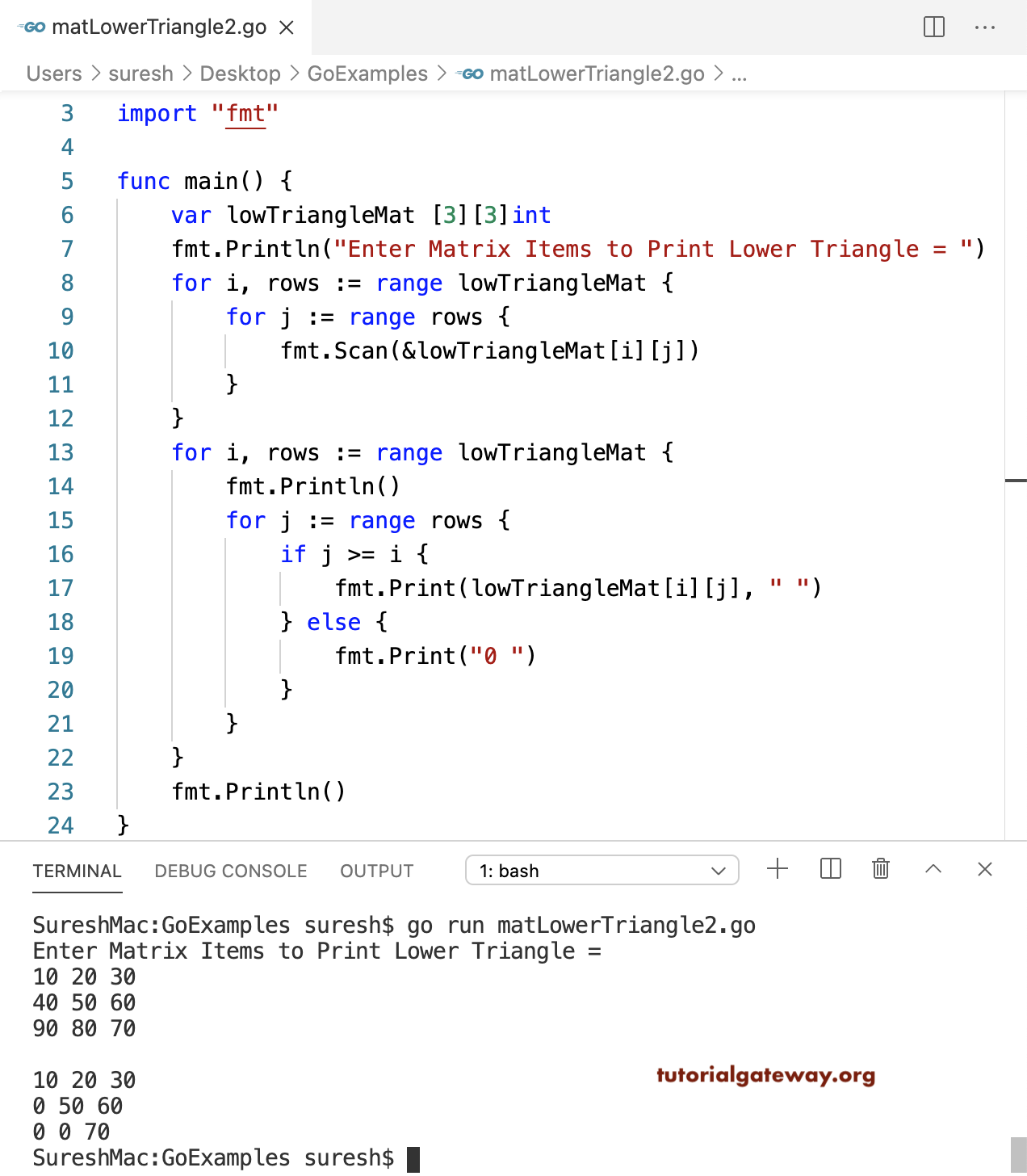
Golang Program to print the Lower Triangle Matrix using For loop range.
package main

import "fmt"

func main() {

    var lowTriangleMat [3][3]int

    fmt.Println("Enter Matrix Items to Print Lower Triangle = ")
    for i, rows := range lowTriangleMat {
        for j := range rows {
            fmt.Scan(&lowTriangleMat[i][j])
        }
    }
    for i, rows := range lowTriangleMat {
        fmt.Println()
        for j := range rows {
            if j >= i {
                fmt.Print(lowTriangleMat[i][j], " ")
            } else {
                fmt.Print("0 ")
            }
        }
    }
    fmt.Println()
}