Write a Go program to perform string concatenation. In this example program, we declared two strings and used an arithmetic operator to concat them.
package main

import (
    "fmt"
)

func main() {

    str1 := "Hello "

    str2 := "World"

    str3 := str1 + str2

    fmt.Println(str3)

}
Hello WorldThis program allows users to enter two different strings and concat them.
package main

import "fmt"

func main() {

    var str1 string

    fmt.Print("Enter the First String to Concat = ")
    fmt.Scanln(&str1)

    var str2 string

    fmt.Print("Enter the Second String to Concat = ")
    fmt.Scanln(&str2)

    str3 := str1 + str2

    fmt.Println(str3)

}
Enter the First String to Concat = Tutorial
Enter the Second String to Concat = Gateway
TutorialGateway
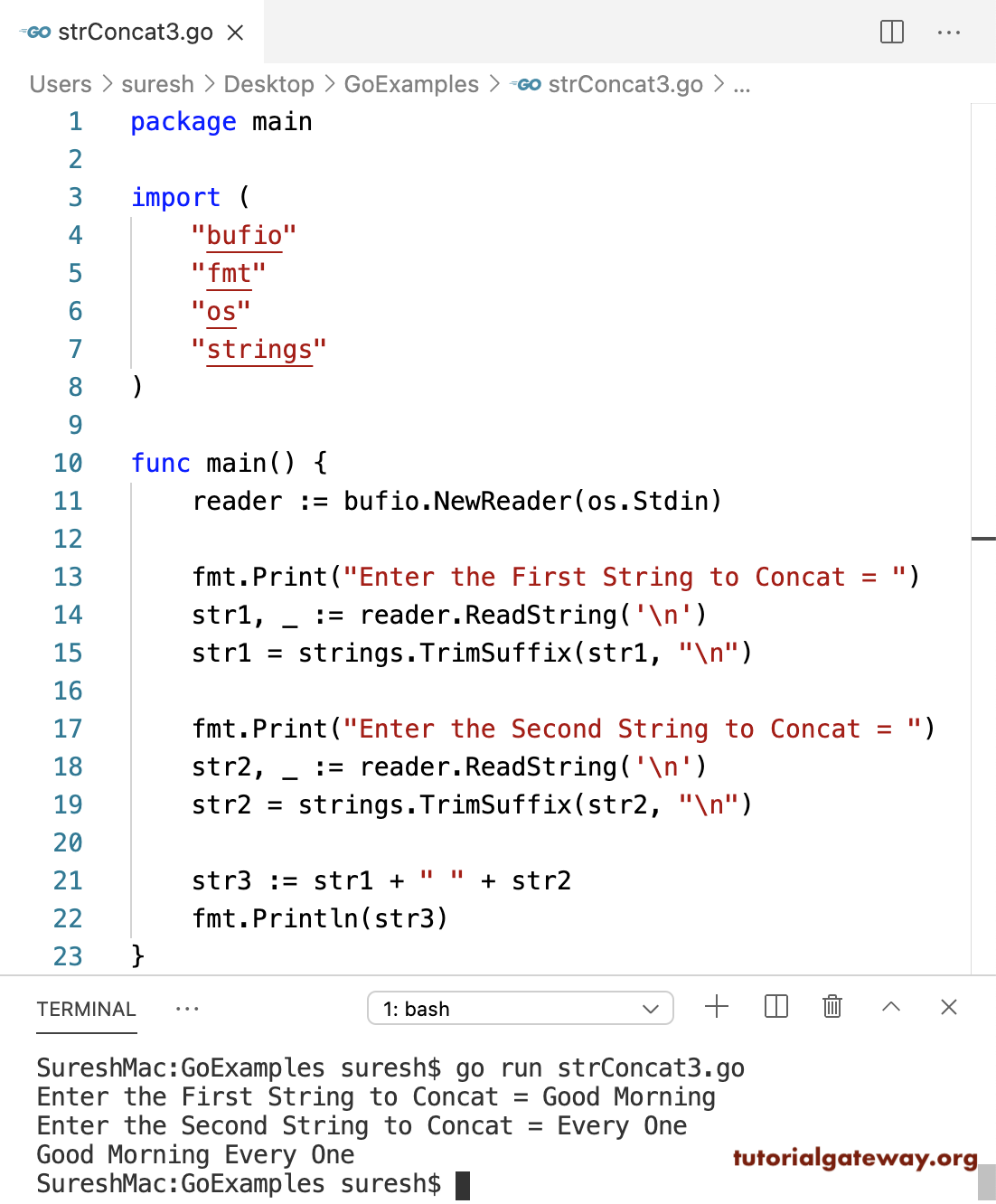
The above concatenation example works with one-word strings. We have to use this example to read the multi-word string user input. This example accepts two strings and concat them using the + operator.
package main

import (
    "bufio"
    "fmt"
    "os"
    "strings"
)

func main() {

    reader := bufio.NewReader(os.Stdin)

    fmt.Print("Enter the First String to Concat = ")
    str1, _ := reader.ReadString('\n')
    str1 = strings.TrimSuffix(str1, "\n")

    fmt.Print("Enter the Second String to Concat = ")
    str2, _ := reader.ReadString('\n')
    str2 = strings.TrimSuffix(str2, "\n")

    str3 := str1 + " " + str2

    fmt.Println(str3)

}