
This go program uses the actual product cost and the sales amount to calculate profit or loss. It uses an else if statement to print output.
- If the product cost is greater than the sales price, then loss.
- If the sales price is higher than the product cost, then the product is profit—otherwise, no profit or loss.
package main

import "fmt"

func main() {

    var pcost, sa, amount int

    fmt.Print("\nEnter the Actual Product Cost = ")
    fmt.Scanln(&pcost)

    fmt.Print("\nEnter the Sale Price = ")
    fmt.Scanln(&sa)

    if sa > pcost {
        amount = sa - pcost
        fmt.Println("Total Profit = ", amount)
    } else if pcost > sa {
        amount = pcost - sa
        fmt.Println("Total Loss = ", amount)
    } else {
        fmt.Println("No Profit No Loss")
    }
}
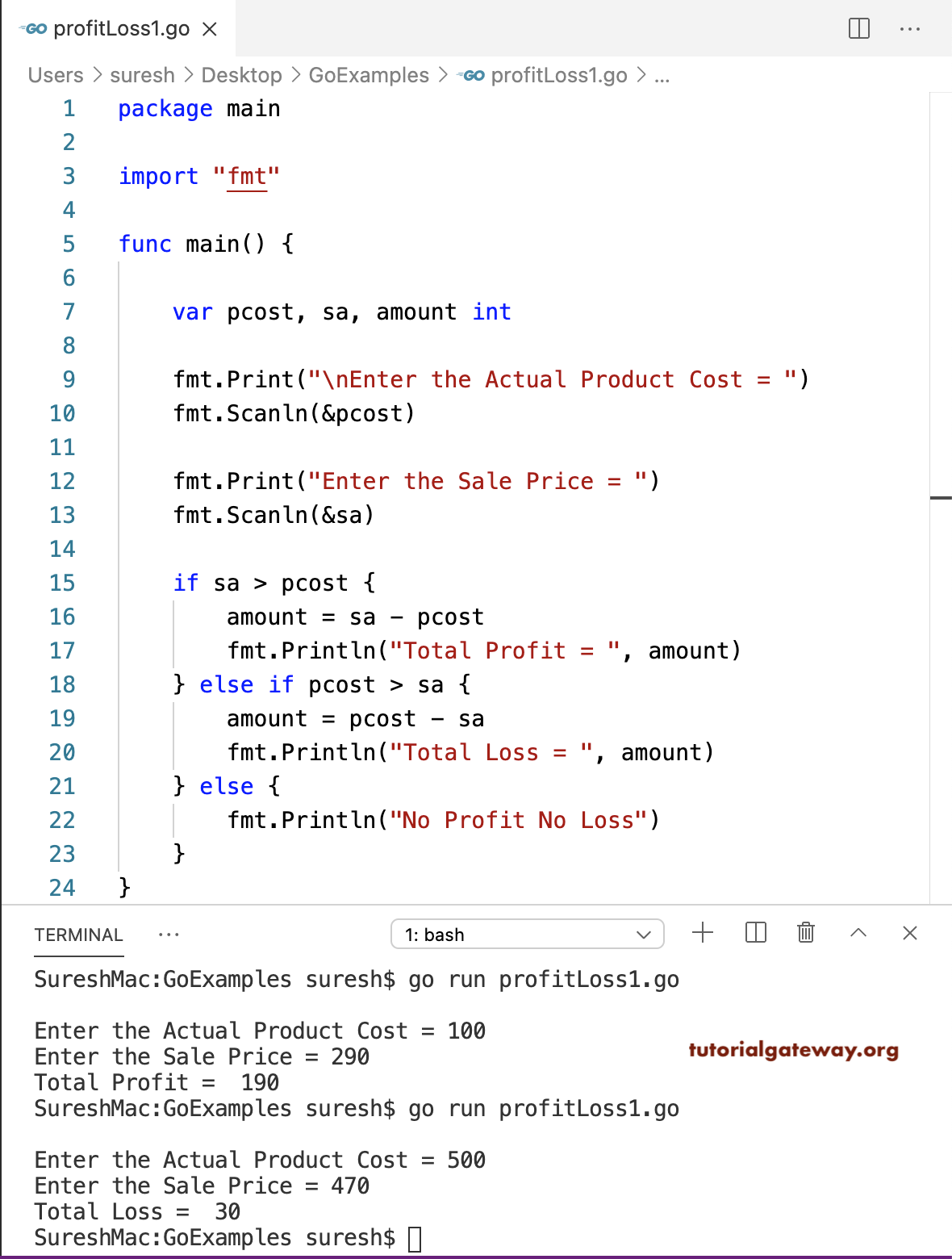
Golang Program to Calculate Profit or Loss
In this go program, we used an arithmetic operator to find the profit or loss.
package main

import "fmt"

func main() {

    var pcost, sa, amount int

    fmt.Print("Enter the Actual Product Cost = ")
    fmt.Scanln(&pcost)

    fmt.Print("Enter the Sale Price = ")
    fmt.Scanln(&sa)

    if sa-pcost > 0 {
        amount = sa - pcost
        fmt.Println("Total Profit = ", amount)
    } else if pcost-sa > 0 {
        amount = pcost - sa
        fmt.Println("Total Loss = ", amount)
    } else {
        fmt.Println("No Profit No Loss")
    }
}
SureshMac:GoExamples suresh$ go run profitLoss2.go
Enter the Actual Product Cost = 1900
Enter the Sale Price = 2500
Total Profit =  600
SureshMac:GoExamples suresh$ go run profitLoss2.go
Enter the Actual Product Cost = 2000
Enter the Sale Price = 1340
Total Loss =  660
SureshMac:GoExamples suresh$ go run profitLoss2.go
Enter the Actual Product Cost = 100
Enter the Sale Price = 100
No Profit No Loss